


A summer in the Med

Whenever I imagined life on a sailing catamaran, it looked something like this: turquoise-blue water, secluded coves, a sundowner in my hand and a feeling of boundless freedom. Waking up in the morning where others are on holiday, weighing anchor and moving on when you’ve had enough of a place.
And yes, those moments do exist. This summer, I saw shades of water that I would have loved to capture forever. We dropped anchor in coves where we were completely alone, drank our first coffee of the morning on the dolphin chair, and spotted glowing plankton in the water during a moonless night-time sail.
But if I had to sum up our summer in the Mediterranean in three words, they’d probably be: exhausting, educational and different from what I’d imagined.
Because there are sometimes quite a few nautical miles between the dream of life under sail and the reality of everyday life on board. And a few repairs.

Our journey: A summer full of islands
Our summer begins in Mallorca. From there, our journey took us first to Menorca, then on to Sardinia, the island of Giglio and Elba. We then explored the north and west of Corsica before heading back to the north of Sardinia and finally returning to Mallorca. From there, we continued on to Formentera and Ibiza, and then in September we set off for Motril (on the Spanish mainland). That’s where our summer came to an end for the time being, whilst the boat was in the shipyard for its underwater paint job.
In total, we covered around 2,500 nautical miles during this time. We spent most of the time at anchor and were rarely in ports.
When I look at the route on a map, it looks like quite an impressive journey. And it certainly was. However, the map doesn’t show how much time elapsed between the individual points. It tells us nothing about weather windows, waves, headwinds, the search for a suitable anchorage, or the many other small tasks that need to be sorted out before you can even set off again.
Our original plan was more ambitious: we wanted to make it all the way to Greece this summer. Instead, we’ve only just made it as far as the Italian mainland.
At first glance, that sounds like quite a big difference between plan and reality. And that’s exactly what it is.
We underestimated how slow travelling by boat is – not necessarily because the speed on the water is so low, but because everything surrounding the actual journey takes up so much time. Added to this are weather conditions that you can’t control, and the realisation that a planned route is, after all, just a plan. Greece isn’t going anywhere. Nevertheless, we first had to learn that when sailing, you can’t simply transfer the kilometres of a road trip to the sea.
Turquoise-blue water and favourite spots
When I think of the most beautiful places I visited this summer, I find it hard to name just one favourite. The experiences were simply too varied.
Stintino in the north of Sardinia was stunning. That turquoise water looks almost unreal. Elba captivated me with its pebble beaches and the intense colours of the sea. And Corsica, with its mountains rising directly behind the coast, offers a completely different landscape.
Menorca has also left a lasting impression on me. The island wasn’t just beautiful; it also surprised me with its friendly and interesting atmosphere. And yet I realise that I don’t necessarily want to settle on one particular place.
Of course, we also explored the mainland. Museums, caves, palaces and castles… But we weren’t always lucky with the opening times. In Corsica, I was really keen to visit Napoleon’s house. It was closed. That’s all part of this sort of trip. Sometimes you find yourself standing in front of a locked door, even though you’d been looking forward to it.

My favourite places are actually those where we’re completely on our own.
When we find a bay where there’s not a single other boat, the water is calm and we’ve simply got the sea all around us, that’s something special for me. No hustle and bustle, no noise from other boats or generators, no neighbours moored just a few metres away. Just us, our boat and the water.
Perhaps that’s the true freedom I’d hoped for from life on board: not to see as many places as possible, but to have the chance to stay wherever it just feels right at that moment.
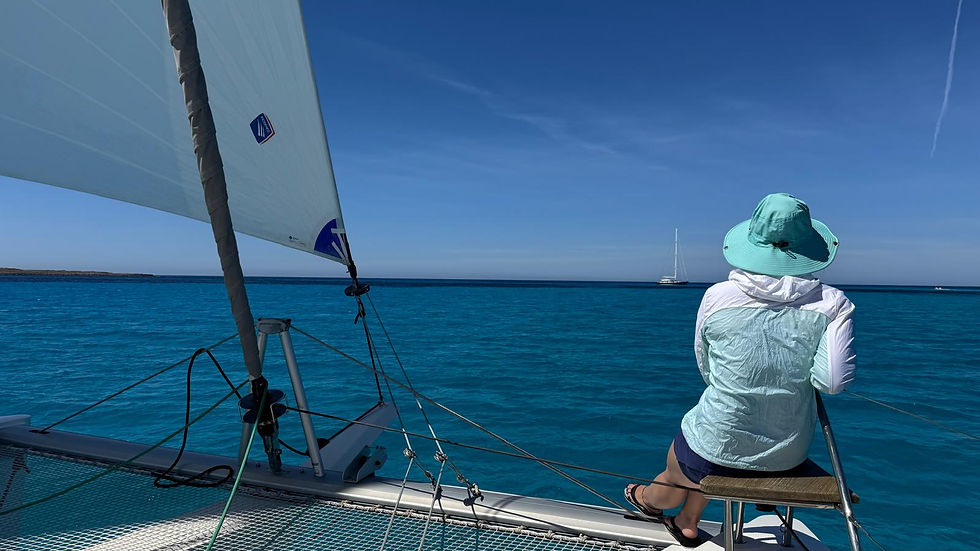
It isn’t necessarily the big adventures that stick in my memory the most. The early morning hours, before the wind picks up, are particularly lovely. When everything is still, the water lies calm and I can sit out on the dolphin chair at the bow with my coffee. There’s nothing that needs doing straight away, no decision to be made, no next item on the agenda.
At least for a moment.
Another experience I won’t forget in a hurry was a night-time trip without the moon. The water around us began to glow. Bioluminescent plankton suddenly made the dark sea magical. Moments like these are almost impossible to capture in a photograph. You have to experience them for yourself.
It’s moments like these that show me why I want to be out on the water. Not because something spectacular happens every day, but because there are moments when the world seems to stand completely still.
And perhaps that is precisely why it is so important to be mindful of them. Because sometimes, on board, we rush from one task to the next so quickly that we almost forget to look around us.
Daily life on board: between 37 degrees and repair mode
As lovely as life on the water is, it’s a far cry from a permanent holiday. Our summer was marred by technical problems and repairs. I’d actually assumed that by now we knew our boat well and were quite well-equipped technically. After all, Denny had spent a lot of time getting to grips with all the technical and mechanical aspects, preparing and maintaining many things, and taking care of them himself.
But apparently I’d underestimated just how many things can break down at the same time – or just how much work even the little things involve. I try to help Denny as best I can. But I’m simply not a qualified mechanical engineer.
Our watermaker needs a major service; the spare parts are already on board. The PDF with the instructions is 24 pages long… it didn’t work out. Our gennaker has been torn to shreds. And there’s a constant stream of maintenance work and repairs, costing us time, money and nerves. No sooner is one job done than the next one is waiting.
I particularly remember the incident with our gennaker off Formentera. Just before sunset, when we were already looking forward to dropping anchor in 10 minutes’ time, a high-speed ferry travelling at around 30 knots and a large motor yacht came towards us, trapping us between them. The cross-waves caused our boat to shake and lurch violently. But it wasn’t just below deck – it was up in the mast too. The strain on the upper part of the mast was too much for our sail – and our gennaker was history. That was definitely not the sort of sailing experience we’d imagined for Formentera.
We’ve since got a replacement: a new gennaker, this time in a lovely shade of pink. Hopefully, that means we won’t be overlooked so easily anymore. If we had to get a new sail anyway, at least let it be one that stands out!
And then there was the heat in Olbia. At times, it was around 37 degrees with what felt like 99 per cent humidity. That’s the sort of weather where you start sweating just from standing around. In any case, we were absolutely delighted with our air conditioning. Without it, it would probably have been hard to bear on board.
We also had some experiences whilst at anchor that I could well have done without. More than one boat drifted into us or got snagged on the bow. One larger one even left a scratch on us.
These are situations in which you realise once again that, whilst you can make many decisions for yourself out on the water, you certainly can’t decide everything. You can drop your anchor carefully and choose your spot well. Nevertheless, you’re always dependent on where other boats are moored, how the wind and current change, and whether everyone is assessing their situation correctly.
And this summer, there was one thing in particular we were waiting for: a proper storm. Time and again, we kept an eye on the weather forecasts and wondered when it might hit us. In the end, we were largely spared. I’m very grateful for that. Because with all the things that can go wrong on board, I certainly don’t need to have to endure a severe storm as well.
If I’ve learnt one thing, it’s this: you’re never really finished with a boat. Never, ever. There’s always something to wait for, improve, repair, clean or reorganise.
Sometimes I wonder if we’ll ever reach a point where everything simply works, but I suppose that’s one of those dreams that, as a boat owner, you’re better off not taking too seriously.
Visitors on board: lovely, but also a logistical challenge
Another important part of our summer was our visitors.
Over Easter, Jasmin and Fabi stayed with us with the children. Then Denny Senior came on board as a long-term guest. Our parents visited twice, and my brother and his friends also spent some time with us on the boat.
I love it when family and friends come to visit us. It’s lovely to share experiences, discover new places together and let the people who matter to me be part of our lives.

At the same time, visiting us on a sailing boat presents a particular challenge: after all, anyone who wants to visit us needs to know the exact location and time. We can’t simply say, ‘Pop round sometime – we’re somewhere in the Mediterranean.’ So we have to plan and organise. We have to work out where we’ll be at any given time, how far we’ll have travelled by then, and whether the weather will be on our side. And suddenly, a journey that’s supposed to thrive on flexibility and freedom is once again bound by fixed deadlines. If the wind isn’t right or a repair takes longer than expected, it isn’t always possible to reach an agreed meeting point as planned – namely by sailing. Sometimes the route has to be adjusted, sometimes the timetable. And sometimes all we can do is hope that everything works out as we’d planned.
On top of that, there’s the issue of living in a limited space. Two people can barely avoid getting in each other’s way on a catamaran. When there are guests on board as well, things don’t necessarily get any quieter. That’s by no means a reason not to have visitors. On the contrary: I’m delighted to be able to share experiences with the people I love. But it does involve work and organisation. And it means that, at times, you have to be more flexible with your schedule than you’d imagined when you envisaged life on the water.
The biggest challenge: two people, a boat and a relationship
There is one challenge that is rarely mentioned in traditional sailing stories: living together on board.
After all, when you’re living on a boat as a pair, you spend a great deal of time together. You share everyday life, make decisions, organise the voyage, deal with repairs and have to cope with all sorts of situations. There’s little scope for privacy and hardly any chance to simply get out of each other’s way for a few hours.
That can be wonderful. But it can also be exhausting.
A challenging crossing, a technical problem, the wrong wind or no wind at all, or a plan gone awry aren’t just practical challenges. They also bring emotions with them: stress, exhaustion, frustration and differing views on how something should be resolved don’t simply disappear just because you happen to be in a beautiful bay.
And this, for me, is where the greatest challenge of our life on board lies: in our relationship. I was already aware that life on a boat would involve a lot of work, that things would break, that we’d have to learn as we went along, and that not everything would always go to plan. But it’s difficult to predict beforehand just how much energy living together and working on our relationship can take.
After all, when there’s a technical problem, things are relatively straightforward. You look for the cause, think about how to solve the problem, order a spare part and fit it. It might take longer than expected, it might end up being expensive, or you might have to improvise. But in the end, at least there’s a specific task and a goal to work towards.
Unfortunately, it doesn’t work quite so simply in a relationship: when something breaks, a spare part won’t help. When things get difficult between two people, you can’t simply order a new part, fit it in and then hope that everything will work again. You have to talk to one another, listen to one another, question your own perspective or patterns, and be prepared to recognise your own part in difficult situations. It requires attention, understanding, trust and a willingness not just to smooth things over in the short term, but to bring about lasting change.
And unlike with a repair, it’s not always immediately clear exactly where the problem lies or what needs to be done in detail to make things better.
I see this as one of the most challenging aspects of our life together. Because no matter how much you look forward to a trip, no matter how many beautiful places you discover, and no matter how much you experience together: the relationship – and the issues you face together – are always part of the journey. You can’t simply sail away from a difficult situation and hope it will sort itself out in the next bay. You take it with you, from bay to bay. And when you live so closely together all the time, the difficulties between two people don’t necessarily get any smaller. That’s why I don’t want to romanticise life on board. It isn’t automatically easier, more harmonious or more fulfilling just because your home is in a beautiful place. Sometimes you’re standing in turquoise-blue water on a stunning beach and still have a lot to sort out between you.
That doesn’t mean the beautiful aspects are any less valuable. But for me, the two go hand in hand: the freedom on the water and the work it takes to make our life together a good one.
We’re constantly learning – whether it’s sailing, navigation, technical matters or how to get on with one another. On every trip, there’s something we realise in hindsight we could have done better. And in a relationship, too, there’s no guarantee that everything will simply be fine again after a difficult patch. It takes time, initiative and a willingness to work on things together.
Whilst a debriefing after a sailing manoeuvre allows you to think carefully about what should be done differently next time, living together as a couple is a challenge in its own right. After all, you can’t simply order a spare part, fit it in and hope that everything will work properly again afterwards.

Expectations and reality: We haven’t quite got there yet
To be honest, our vision of our dream life hasn’t quite matched up with reality so far.
The images in our minds were, of course, lovely: new countries, long sailing legs, idyllic islands and the feeling of finally having arrived at what we’d been working towards for so long. The reality is more complicated:
It feels as though we’re working harder than ever before. There’s always something to do, and no sooner is one task finished than the next is already waiting. Our journey is progressing more slowly than planned. We spend a lot of time on things that don’t feature in any holiday photos. We’d set out to sail all the way to Greece. Instead, we’ve learnt that not every journey has to go according to the original plan. And perhaps it’s all right not to feel as though you’ve achieved something great after every stage. Sometimes, progress simply means coping with a difficult situation better than you did last time.
What remains of this summer
Looking back over the past few months, I see a summer full of contrasts:
We’ve discovered beautiful places, swum in stunning waters and found secluded anchorages. We’ve laughed, had new experiences and covered around 2,500 nautical miles. But we’ve also worked hard, carried out repairs, changed our plans and learnt that life on a boat requires far more patience than we’d expected.
Above all, I’m grateful that we’ve been spared any severe storms. That’s not something to be taken for granted, and I know that things could have turned out very differently at sea.
The next leg of our journey takes us to Madeira, where we’ll be spending the winter. Greece, however, remains on our mental map. Nevertheless, I’m trying not to stick quite so rigidly to a specific route or timetable. Because if there’s one thing I’ve learnt from this summer, it’s probably the realisation that life on board isn’t just made up of the moments we set sail for. It also consists of all the things in between: of repairs you hadn’t planned for; of visits that bring joy but require organisation; of decisions you have to make together; of small successes, setbacks and the attempt to learn something from every voyage.
And, of course, of those moments when I sit on the bow in the morning with my coffee and the world seems completely still for a while.
It’s lovely that you’re joining us on our journey. We’d be delighted if you’d be on board again for our next adventure!
Fair winds and ahoy
Anja & Denny


Comments